Key Insights
Paychex
- Best suited for U.S. SMBs that want an integrated payroll + HR + benefits ecosystem.
- Scalable, but complexity increases as needs grow beyond basic payroll.
ADP
- Strong choice for larger businesses or those requiring global payroll, deep compliance tooling, and advanced analytics.
- Offers the broadest suite of HR tools, but with higher complexity.
Capital Payroll Partners
- Tailors services to small and medium-sized businesses with a focus on 24/7 cloud access, customizable reporting, and real-time payroll processing.
- Customer feedback highlights responsive support and ease of use for small business payroll management.
- Pricing is custom and quote-based, similar to the larger providers.
Table of Contents
- Overview of Paychex and ADP
- What Is Paychex?
- What Is ADP?
- ADP vs Paychex Reviews
- Core Features Comparison
- Ease of Use and User Experience
- Pricing and Plans
- Customer Support
- Pros and Cons of Paychex
- Pros and Cons of ADP
- What Is the Best for Small Businesses?
- What Is an Alternative to Paychex and ADP?
- Choose the Payroll Solution That Fits Your Business
Selecting payroll software affects compliance exposure, operational efficiency, and total cost of ownership. Businesses often compare Paychex and ADP because both providers hold significant market share, but pricing opacity and feature overlap make direct comparison difficult.
Employers face the challenge of evaluating whether the additional cost of a larger provider justifies the investment, or if a regional alternative better serves their needs. For businesses looking to scale (such as those we know in Fairfax or Stafford), choosing between national giants and local experts is the first step in future-proofing your operations and ensuring your back-office can handle rapid expansion.
This comparison analyzes Paychex and ADP, detailing differences in pricing, payroll features, compliance, customer support, and alternatives, to help employers make informed decisions based on factual needs.
Overview of Paychex and ADP
Both Paychex and ADP operate as full-service payroll providers with multi-state capabilities. Paychex processes payroll for approximately 800,000 clients, while ADP serves over 1 million businesses globally. The companies compete across similar market segments, from small businesses to enterprises.
Market positioning differs primarily in scale and specialization. ADP maintains a stronger enterprise presence with deeper international capabilities, while Paychex concentrates more heavily on small to mid-sized businesses in the United States. Both providers offer HR services, benefits administration, and time tracking as add-ons.
What Is Paychex?
Paychex is a payroll, HR, and benefits administration company that helps businesses of all sizes manage payroll processing, tax filing, compliance, and workforce administration through its cloud platform Paychex Flex. It supports employers ranging from solo entrepreneurs and small businesses up through large organizations, with flexible payroll packages that scale as needs grow.
Regional Scaling Note: Small firms in Richmond or Virginia Beach often find that a system designed specifically for SMBs allows them to scale their headcount without the administrative bloat associated with enterprise-level software.
At its core, Paychex enables automated payroll processing, federal and state tax calculation and filing, direct deposit, and year-end reporting, relieving employers of manual calculations and reducing compliance risk. Through Paychex Flex integrations, the platform connects with accounting systems like QuickBooks, Sage Intacct, and Xero, as well as time-tracking and HR tools, to streamline workflows and centralize data.
Beyond payroll, Paychex provides HR administration services, including recruiting and onboarding tools, compliance guidance, workforce analytics, and access to HR specialists to support legal and regulatory needs. Its HR services also cover time and attendance tracking, employee benefits such as health plans and 401(k) retirement administration, and workers’ compensation insurance through associated services. These features are part of Paychex’s broader HR solutions suite.
Employees and employers can access payroll data, pay stubs, tax forms, and self-service tools through Paychex’s web and mobile interfaces, improving accessibility and reducing administrative burden. Paychex supports customized support levels, including on-demand help and dedicated payroll specialists on select plans to assist with complex payroll and HR questions.
Overall, Paychex combines payroll automation, HR management, tax compliance assistance, and benefits administration in a single platform designed to help businesses reduce errors, stay compliant with regulations, and focus more on operations than back-office processing.
What Is ADP?
ADP (Automatic Data Processing, Inc.) is a global provider of payroll and human capital management technology, serving organizations from small businesses to multinational enterprises. Its core platforms include RUN Powered by ADP for small businesses, ADP Workforce Now® for mid-market organizations, and enterprise-level solutions such as ADP GlobalView® Payroll for complex multinational operations.
Global Growth Insight: For companies in Washington, DC with multinational aspirations, the ability to scale into global markets is a critical factor when evaluating platforms like ADP that support complex international footprints.
ADP delivers global payroll and HR services in over 140 countries, positioning it as one of the world’s largest payroll providers by operational footprint and processing scale. This global infrastructure supports localized payroll execution, tax compliance, and regulatory alignment across diverse jurisdictions. Learn more about ADP’s global capabilities on its official international payroll platform page.
Standard services include automated payroll processing, federal and state tax calculation and filing, direct deposit, garnishment administration, and year-end reporting such as W-2 and 1099 generation. ADP also maintains internal compliance and regulatory monitoring functions that track legislative and tax changes to help businesses remain aligned with evolving requirements. These capabilities are detailed in ADP’s payroll and tax compliance services overview.
The platform supports API integrations and custom data connections through ADP API Central and the ADP Marketplace, enabling integration with accounting systems, HR tools, time-tracking software, and enterprise platforms for unified data flow and operational automation.
Beyond payroll, ADP offers modular HCM functionality, including benefits enrollment, onboarding, applicant tracking, performance management, and learning management systems, available through tiered plans and enterprise HCM solutions. These services are part of ADP’s broader HCM product ecosystem.
Note for accuracy: ADP does not publicly advertise a universal tax penalty protection guarantee across all service plans in its general product documentation. While compliance tools and regulatory monitoring are core features, liability guarantees for filing errors typically depend on specific contractual terms rather than standard platform coverage.
ADP vs Paychex Reviews
ADP is described as operationally reliable but structurally frustrating, a platform that usually “runs payroll reliably,” yet becomes difficult the moment something goes wrong. As one user put it, “ADP is reliable until it isn’t. Runs usually process, but fixes can take time and involve multiple handoffs.”

It is often portrayed as the “least bad” option in a difficult market. Users acknowledge persistent issues but still credit the system with getting core payroll functions done: “Our employees are always paid on time, and the calculations are correct, and our tax filings are correct.”
Support, however, is a dominant pain point:
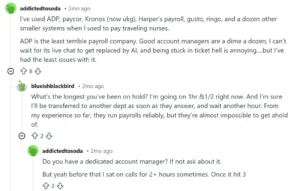
Paychex, on the other hand, is portrayed in reviews as simple in concept but deeply frustrating in execution, particularly in terms of service, reliability, and operational control. Even users who acknowledge that the software can technically handle payroll describe the overall experience as negative, with one bluntly stating, “I use Paychex. It sucks. Customer service is beyond sucky.”
It is frequently framed as a system that may function for small, low-complexity organizations, but quickly becomes unworkable as needs grow. As one payroll veteran puts it, “100 employees may not be too difficult for Paychex to handle, as long as there’s nothing too complex… they’re the worst I’ve seen.”

Customer service is the dominant failure point, as it is with ADP. Users describe inaccessible representatives, outsourced communication, voicemail-only contact, and slow response times that clash with the time-sensitive nature of payroll. One reviewer summarizes the experience:


Across both threads, the technology behind ADP and Paychex is consistently portrayed as functional but fundamentally outdated and restrictive, built more for stability than adaptability. ADP is described as a system where the tech itself feels fragmented and legacy-driven. Paychex, meanwhile, is framed as clunky and limiting rather than robust. Together, the reviews portray both platforms as technologically conservative: capable of running payroll but lacking modern flexibility, intuitive design, and operational autonomy—systems that work, but rarely empower users.
Overall, ADP is generally seen as dependable for payroll execution, but its support is difficult, and the system is sustained more by market presence than user satisfaction. In contrast, Paychex is described as structurally unreliable, plagued by poor support, limited user autonomy, and declining trust, leading to outright rejection from many users.
Core Features Comparison
Paychex and ADP deliver very similar core payroll functionality, with both platforms supporting automated payroll processing, multiple pay schedules, federal and state tax calculations, and electronic tax filing. Each system enables businesses to pay employees through direct deposit, paper checks, and payroll cards, while managing quarterly and year-end reporting requirements. Independent comparisons confirm that both providers offer full-service payroll with compliance support as a standard feature, making them functionally comparable at the core payroll level.
Tax Compliance
Both companies handle electronic filing of federal and state payroll taxes, as well as related compliance processes such as new-hire reporting and ongoing payroll tax management. ADP is widely recognized for its stronger compliance infrastructure, including internal tax research teams and systems designed to monitor regulatory changes across all states, positioning it as a compliance-focused provider. ADP also publicly markets tax filing support and penalty protection in cases of system-caused errors, while Paychex offers tax filing services and compliance support through Paychex Flex, though specific tax guarantee terms vary by contract and service tier (Paychex tax services).
As a business grows in cities like Norfolk or… Manassas, VA, the complexity of multi-state tax filing increases. You need a partner that scales its compliance support alongside your expanding geographic footprint!
Time and Attendance
Time tracking is typically offered as an add-on module by both platforms. ADP integrates time and attendance tools into its Workforce Now ecosystem, allowing time punches to sync directly with payroll processing. Paychex provides similar functionality through Paychex Flex Time, which connects employee hours, scheduling, and attendance data directly into payroll workflows. Both ecosystems support hardware time clocks and mobile time tracking through their respective partner networks.
Reporting
ADP is consistently recognized for more advanced reporting and analytics tools, including customizable reports, dashboards, and data visualization features designed for mid-market and enterprise clients (ADP analytics). Paychex focuses more on standardized payroll and tax reporting, including payroll registers, tax liability summaries, and compliance documentation, which meet operational needs but offer fewer advanced analytics features by comparison.
HR Tools
Both providers offer HR tools as part of higher-tier service plans rather than as core payroll features. ADP provides HR resources such as onboarding tools, compliance documentation, employee records management, and workforce management solutions through its modular platform structure (ADP HR solutions). Paychex offers comparable functionality through its HR Solutions and Paychex Flex platform, including onboarding, HR compliance tools, benefits administration, and HR advisory services. Neither platform positions itself as a direct provider of legal representation for employment disputes, with legal services typically handled through third-party partnerships or external counsel.
Ease of Use and User Experience
Paychex Flex is widely described as user-friendly, with a dashboard-based layout that provides quick access to core payroll and HR functions from the home screen. Reviews commonly note intuitive navigation and clear presentation of payroll data, making it accessible for businesses without dedicated payroll teams. The Paychex mobile app provides access to key features such as pay stubs, time tracking, scheduling, and employee self-service tools, offering a streamlined version of the desktop experience.

ADP’s user experience varies by product. ADP RUN, designed for small businesses, is generally considered easy to navigate and suitable for basic payroll operations. In contrast, ADP Workforce Now is a more robust platform built for larger organizations and complex workflows. While it offers greater configuration options, integrations, and compliance tools, users often report a steeper learning curve due to its broader feature set and higher operational complexity.

Both Paychex Flex and ADP platforms include employee self-service portals, allowing workers to access pay stubs, tax documents, benefits information, and time-off requests. The level of employee control over updates (such as tax withholdings or personal data) depends on employer settings and administrative permissions.
Initial setup for both systems typically includes guided onboarding or implementation support, while ongoing administration is managed by the employer, with access to customer support as needed. As cloud-based platforms, both systems are maintained centrally by the providers, with updates and system maintenance handled at the platform level rather than requiring manual software installations by users.
Pricing and Plans
Neither Paychex nor ADP publishes fully transparent, standardized pricing across all service tiers. Both providers operate on a custom-quote pricing model, where costs are based on variables such as employee count, pay frequency, state tax jurisdictions, and selected modules. According to industry comparisons from Forbes Advisor, pricing is typically structured as a base monthly fee plus per-employee charges, with additional costs for optional services and integrations.

Because of this model, businesses must request tailored quotes directly from each provider, and pricing can vary significantly even between similar-sized companies.
When scaling a business in locations like Lynchburg, predictable pricing models are essential for long-term budgeting. Custom quotes ensure your payroll costs remain aligned with your specific growth trajectory.
Paychex Pricing Structure
Paychex Flex is organized into multiple service tiers, with limited publicly available pricing.
The entry-level plan, Paychex Flex Essentials, is one of the few tiers with published pricing and is commonly listed at $39 per month plus $5 per employee, covering core payroll processing, tax administration, employee self-service, and mobile access, according to third-party software reviews.
Higher-level tiers — including Paychex Flex Select, Paychex Flex Pro, and Enterprise — require custom quotes and are not publicly priced on the Paychex website. Industry comparisons and payroll software analysts report that mid-tier plans may fall within a range of approximately $47 to $95 per month plus per-employee fees, though these figures vary by services selected and are not officially confirmed by Paychex.
Additional costs may apply for add-on modules such as time tracking, benefits administration, HR compliance tools, and advanced reporting. Payroll industry reviews note that total costs are influenced by both feature selection and service scope, making detailed quotes essential for accurate budgeting.
While contract structures vary, many businesses report annual service agreements with recurring billing, emphasizing the importance of reviewing renewal and pricing adjustment terms during the sales process.
ADP Pricing Structure
ADP follows a similar custom-pricing model and does not publish standard rates for most of its payroll and HR platforms. Businesses are required to request tailored quotes based on company size, compliance requirements, and service complexity.
For small businesses, RUN Powered by ADP is commonly reported by pricing analysts to start at approximately $79 per month plus $4 to $6 per employee, depending on service tier and features included. ADP RUN is offered in multiple tiers, including Essential Payroll, Enhanced Payroll, Complete Payroll & HR Plus, and HR Pro, with costs increasing based on added HR and compliance features.
For mid-sized organizations, ADP Workforce Now pricing varies widely. Industry analysts estimate that bundled payroll and HR services typically range from $23 to $30 per employee per month, while more comprehensive outsourced HR services may exceed this range depending on complexity and service level agreements.
Implementation and onboarding fees are also reported, with pricing guides estimating setup costs ranging from several hundred to several thousand dollars, depending on data migration needs, integrations, and configuration requirements.
Contracts commonly involve multi-month or multi-year agreements, making long-term cost forecasting and contract review essential before signing.
Cost Comparison
Because both providers rely on individualized pricing models, direct cost comparisons are inherently difficult without custom quotes. Industry pricing estimates suggest that:
- Small businesses with around 10 employees running basic payroll often pay in the low hundreds per month at entry-level tiers with either provider.
- Companies with 50 employees using payroll, tax filing, and basic HR support typically fall into a mid-hundreds monthly range, depending on selected features and service tiers.
Customer reviews and payroll procurement guides frequently reference annual price increases, limited pricing transparency, and restricted post-contract negotiation flexibility, reinforcing the importance of reviewing automatic renewal clauses, escalation terms, and add-on pricing structures before committing to long-term agreements.
Customer Support
Paychex is widely known for its dedicated account representative model, where many clients are assigned a specific payroll or HR specialist for ongoing support. This structure provides businesses with direct phone and email access to a consistent contact, rather than rotating support agents. According to payroll service reviews and software comparison platforms, Paychex emphasizes relationship-based support as a core part of its service model.
Support availability is primarily during standard business hours, with some service tiers offering extended coverage. While emergency support options exist, most assistance is delivered through scheduled support channels rather than 24/7 general access. User reviews indicate that response times for routine, non-urgent requests typically range from same-day to next-business-day resolution, depending on account type and service tier.
ADP operates a tiered customer support structure based on service level and contract tier. Entry-level plans typically provide access to centralized support lines, while higher-tier plans and enterprise accounts often include dedicated account managers or service representatives. This support model is documented across payroll software comparison platforms and HR technology analysts.
ADP also distinguishes itself with 24/7 payroll support for critical issues, including emergencies such as failed direct deposits, payroll processing failures, and urgent tax-related errors. This always-on payroll assistance model is a frequently cited feature in enterprise payroll evaluations.
Shared Support Resources
Both platforms maintain online knowledge bases and self-service support centers, providing access to documentation, help articles, and troubleshooting guides for common payroll and HR scenarios (Paychex support center, ADP help center).
Live chat functionality is available on the two platforms, though availability and response times vary by service tier and account type, with priority access typically reserved for higher-level plans.
For onboarding, even one and the other provide structured implementation support, including system configuration, data migration, and training resources. Industry reviews indicate that implementation assistance typically covers the initial onboarding phase, after which accounts transition to standard support channels and service models.
Pros and Cons of Paychex
Advantages
- Strong SMB focus: Paychex is well-positioned for small to mid-sized businesses, offering scalable payroll and HR solutions that grow with company needs.
- All-in-one platform: Payroll, tax filing, HR administration, benefits management, time tracking, and compliance tools are integrated into the Paychex Flex ecosystem.
- Dedicated account representatives: Many plans include access to a consistent payroll specialist, improving continuity and relationship-based support.
- Multi-state payroll capability: Supports payroll processing and tax compliance across multiple U.S. jurisdictions.
- Accounting and software integrations: Integrates with platforms like QuickBooks, Sage Intacct, and Xero, improving workflow automation.
- Employee self-service tools: Employees can access pay stubs, tax forms, and payroll information through web and mobile portals.
- Flexible service tiers: Offers tiered plans that allow businesses to start with payroll and expand into HR, benefits, and compliance services as needed.
Disadvantages
- Customer service reliability issues: Reviews frequently cite inconsistent support quality, slow response times, and difficulty reaching representatives.
- Limited pricing transparency: Most plans require custom quotes, making cost comparison difficult.
- Operational scalability concerns: Often reported to struggle as organizations grow in complexity (multi-state, complex compliance, large headcounts).
- Technology limitations: Described as functional but clunky, with a more conservative, legacy system feel.
- Limited user autonomy: Administrative controls and system flexibility are often reported as restrictive.
- Additional costs for core features: Many essential tools (HR, time tracking, benefits, analytics) are add-ons rather than included features.
- Contractual rigidity: Recurring billing structures, renewal clauses, and limited post-contract negotiation flexibility are common concerns.
Pros and Cons of ADP
Advantages
- Enterprise-grade infrastructure: ADP is one of the largest payroll providers globally, supporting businesses in over 140 countries.
- Strong compliance capabilities: Advanced regulatory monitoring, tax calculation systems, and internal compliance teams.
- Reliable payroll execution: Consistently described as dependable for core payroll processing and tax filing accuracy.
- Product segmentation by business size: Platforms like RUN Powered by ADP, Workforce Now, and GlobalView Payroll align with different organizational scales.
- Advanced reporting and analytics: Particularly strong in mid-market and enterprise environments.
- Robust integration ecosystem: APIs, ADP Marketplace, and enterprise system integrations support operational automation.
- 24/7 payroll emergency support: Critical payroll issues are supported around the clock.
- Global payroll capabilities: Suitable for multinational operations and complex compliance environments.
Disadvantages
- Complex user experience: Especially in Workforce Now, users report steep learning curves and operational complexity.
- Fragmented platform structure: Legacy system architecture leads to disconnected workflows and inconsistent interfaces.
- Customer support friction: Long resolution cycles, multiple handoffs, and bureaucratic support processes are common complaints.
- Opaque pricing model: Custom quotes, limited transparency, and difficulty comparing plans.
- High total cost of ownership: Costs increase significantly as features, modules, and compliance services are added.
- Contractual lock-in: Multi-year contracts and limited renegotiation flexibility are common.
- Slow issue resolution: When errors occur, fixes often involve multiple departments and extended timelines.
- Technology conservatism: Built for stability over flexibility, limiting adaptability and innovation speed.
| Category | Paychex | ADP | Capital Payroll Partners |
| Core Features | Full payroll + tax filing, HR add-ons, benefits admin, integrations with accounting systems; scalable for SMBs to mid-size. | Full payroll + tax filing, global HR suite, advanced integrations, and enterprise features across product tiers. | Cloud-based payroll with real-time processing, employee self-service, tax filing, customizable reporting, and time & attendance integration. |
| Tax Compliance | Handles federal/state tax filing and compliance tools; tax guarantee varies by contract. | Strong compliance infrastructure with internal research teams and regulatory monitoring across jurisdictions. | Built-in tax compliance with tax professionals maintaining tax rates and filing federal/state taxes electronically. |
| Time and Attendance | Offered as an add-on module with integration into payroll flow. | Integrated into the Workforce Now ecosystem with synchronization into payroll. | Integrated time and attendance with payroll; includes scheduling, PTO requests, and time tracking. |
| Reporting | Standard payroll and tax reporting; limited advanced analytics. | Advanced reporting and analytics for mid-market and enterprise clients. | Real-time, customizable payroll reports exportable in multiple formats (PDF/Excel/CSV). |
| HR Tools | HR add-ons, onboarding, compliance guidance, and benefits admin are available at higher tiers. | Modular HCM suite including onboarding, recruiting, performance, benefits, and enterprise HR tools. | Human capital management features include onboarding, applicant tracking, employee recordkeeping, and reports. |
| Ease of Use & User Experience | Dashboard-based with mobile access; generally approachable for SMBs, though some users find workflows clunky. | Powerful but often more complex, especially at the enterprise tier; steeper learning curve. | Cloud dashboard with real-time access from any device and an intuitive self-service portal. |
| Pricing & Plans | Custom quotes; pricing not publicly standardized; base + per-employee + add-ons. | Custom quotes; multi-tier pricing varies by platform and features. | Custom pricing via instant quotes based on employees, pay frequency, and features; no published rates. |
| Customer Support | Dedicated reps on many plans; standard business hours support with some extended availability. | Tiered support, including 24/7 payroll emergency support and dedicated account managers at higher levels. | Personalized and responsive support geared to SMBs, with reviews highlighting quick responses and strong client relationship focus. |
What Is the Best for Small Businesses?
Small businesses with under 50 employees typically prioritize simplicity, cost predictability, and responsive support. Companies with straightforward payroll needs and limited multi-state exposure may find Paychex sufficient.
ADP RUN competes effectively for small businesses requiring advanced reporting or planning for future growth. The platform scales more easily as employee counts increase, reducing migration needs. Businesses with complex payroll requirements, such as tips, commissions, or shift differentials, benefit from ADP’s calculation flexibility.
Neither platform clearly dominates the small business segment. Selection depends on specific priorities: user experience versus reporting depth, support model preference, and tolerance for pricing variability. Businesses should evaluate actual quotes against feature requirements rather than relying on general recommendations.
What Is an Alternative to Paychex and ADP?
Several payroll providers offer comparable services at different price points and service models. Gusto targets small businesses with transparent pricing and modern interfaces. Paycor serves mid-market companies with industry-specific features. Rippling combines payroll with IT management for technology-focused businesses.
Regional providers often deliver more personalized service at competitive rates. Local payroll companies maintain direct relationships with state tax agencies and understand jurisdiction-specific requirements. These providers typically offer flexible contract terms and faster response times compared to national vendors.
Capital Payroll Partners specializes in guaranteed payroll compliance with dedicated local support. The company provides full-service payroll, tax filing, and HR guidance with accuracy verification before submission. The company guarantees tax compliance and covers penalties and fees for any tax errors caused by the company, while providing direct access to payroll specialists familiar with regional wage laws, unemployment insurance procedures, and local tax requirements.
Choosing between national platforms and regional specialists depends on geographic footprint, preference for local expertise, and importance of contract flexibility. Businesses operating primarily within specific states often achieve better outcomes with providers focused on those jurisdictions.
Local Advantage: Regional providers offer a unique advantage for businesses in Stafford that want to scale with a partner who understands local unemployment insurance procedures and specific Virginia tax requirements.
Choose the Payroll Solution That Fits Your Business
Paychex and ADP deliver reliable payroll processing with comprehensive tax compliance. Paychex offers simpler navigation and dedicated support, while ADP provides more robust reporting and global capabilities. Pricing structures remain similar, with neither provider offering clear cost advantages across all scenarios.
Businesses should evaluate specific feature requirements, contract terms, and support models before committing to multi-year agreements. Regional alternatives often provide comparable services with greater flexibility and localized expertise.
Capital Payroll Partners offers full-service payroll with regional compliance expertise and flexible service terms. Contact Capital Payroll Partners to review pricing and service options specific to your business requirements.